Case study 03 · AI health · Multi-user product · 2025
Luniby: triage that calms owners and unblocks clinics
An AI-assisted petcare platform that gives anxious owners a clear next step and hands vet nurses a structured summary, so triage stops eating consultation time.
- Role
- UX research, UX/UI design and front-end build, end to end
- Challenge
- Design one system for three very different users (anxious owners, time-stretched nurses, clinic admins) and make AI reasoning trustworthy to all of them.
- Type
- Product, 0 to 1
- Users
- Pet owners, vet nurses, clinic admins
- Tools
- Figma, Miro, User Interviews

01 · What is it, and what did I own?
ConductedOverview
Luniby connects pet owners, veterinary nurses and clinics in one ecosystem: early detection and triage for the owner, a structured summary for the nurse, and visibility for the clinic.
I owned it end to end: the research, the interface and the front end that shipped. There was no handover between deciding something and building it, which is why design decisions could be tested in a working product quickly.
02 · Where was the pain?
ConductedThe problem
Clinic burnout, fragmented triage and anxious owners create pain across the whole petcare journey, and nothing connects early detection, triage and follow-up.
Owners
Average anxiety of 8.2/10 during symptom discovery, with no immediate reassurance.
Clinics
About 40% of consultation time spent on triage that could be pre-screened (time-motion study).
Continuity
Several disconnected touchpoints, so care restarts from zero at every step.
03 · What was the evidence?
ConductedResearch
Research covered every stakeholder group, in Auckland and across New Zealand and Australia, so the design could be tested against owners, nurses and administrators rather than one of them.
One interview captured the whole brief: "My dog started limping and I panicked. Is it an emergency or can I wait? I called three clinics and they were all fully booked. I just needed someone to tell me if this was urgent." (Pet owner, 28, Auckland, December 2024)
32 interviews
18 pet owners (24 to 55), 8 veterinary nurses and 6 clinic administrators.
12 hours of observation
Shadowing an Auckland clinic to see triage workflow and staff pain points first-hand.
150+ survey responses
Owners across NZ and AU on triage behaviour and anxiety. 82% were interested in AI triage and 67% would pay.
Service blueprinting
Journey mapping across anxious owners, stretched nurses and clinic operations.
04 · How do the users share one system?
ConductedOrchestrating three journeys
Each user type gets a distinct experience, but all of them draw on the same data. The owner's symptom entry becomes the nurse's Health Note, which feeds the clinic's queue and analytics.
Pet owner
01
Symptom entry
Describes symptoms via chat
02
AI triage
Receives urgency assessment
03
View Health Notes
Reviews AI summary
04
Book appointment
Schedules with clinic
05
Follow-up care
Receives aftercare guide
Vet nurse
01
Receive notes
Pre-screened patient data
02
Priority review
Confirms urgency level
03
Manage queue
Schedules appointments
04
Post-consult
Updates patient record
Clinic admin
01
View dashboard
Monitors clinic activity
02
Manage resources
Allocates staff and time
03
Review analytics
Reports and billing data
05 · How is it organised?
ConductedInformation architecture
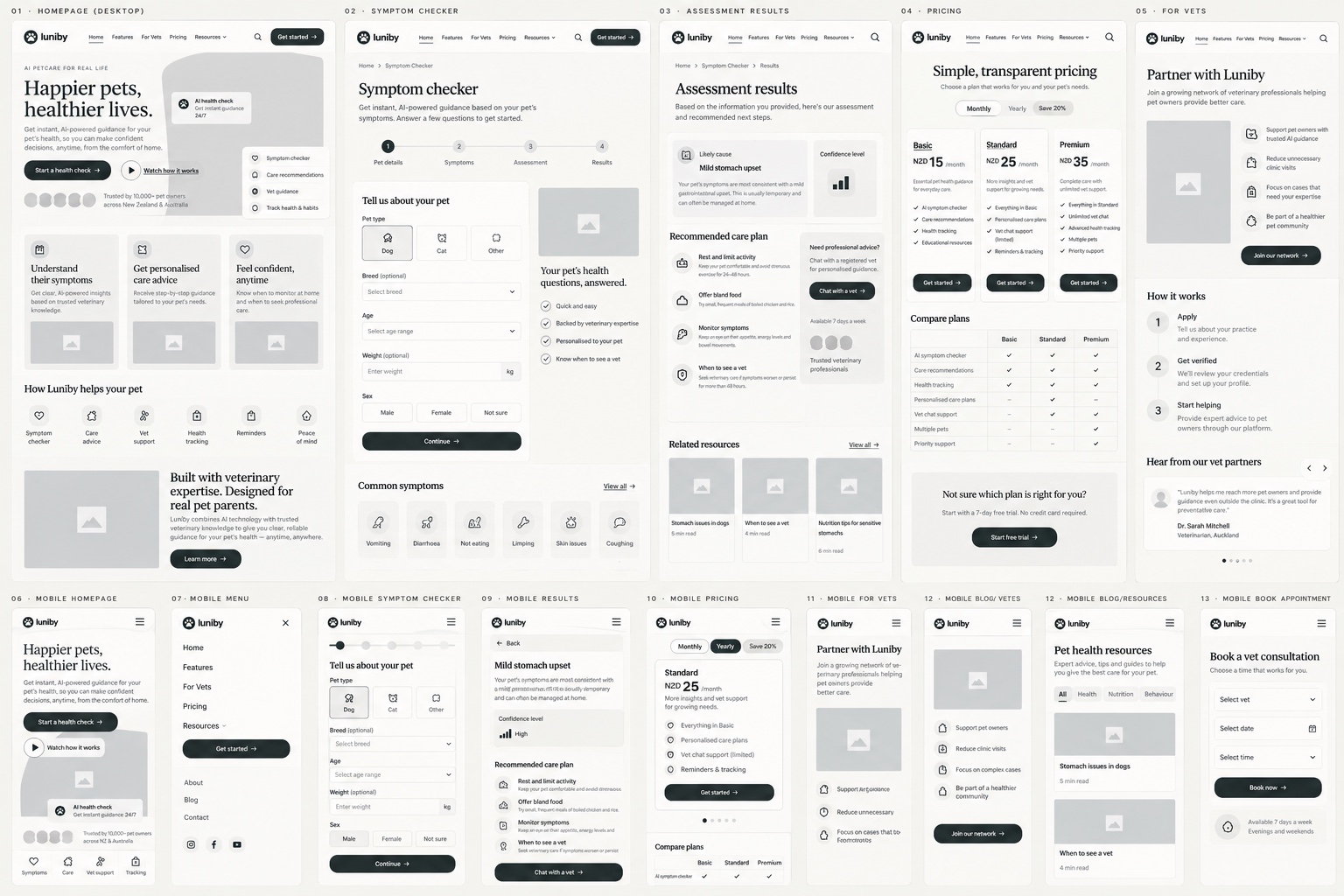
Three portals, each scoped to one job. Wireframes started as rough sketches of the triage chat, then moved to mid-fidelity and were tested with 15+ users to validate flow and comprehension.
Owner portal
- Pet profiles
- Symptom assessment
- Triage results
- Health records
- Consultation booking
Nurse portal
- Incoming triage queue
- Health Notes review
- Priority scoring
- Clinic scheduling
Clinic admin portal
- Dashboard analytics
- Staff management
- Integration settings
- Billing
06 · How do the screens work?
ConductedWireframes
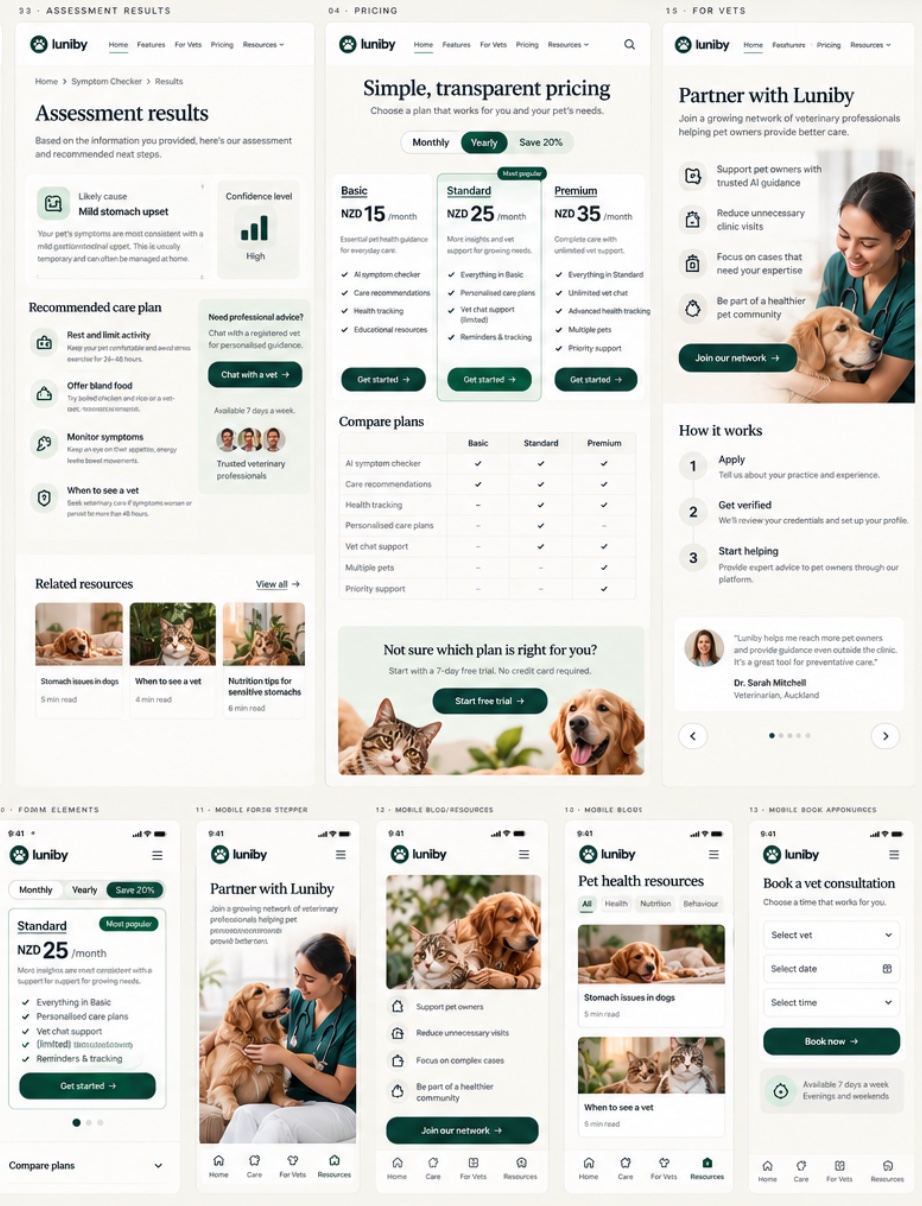
Wireframes began as rough sketches of the triage chat, then moved to mid-fidelity and were tested with 15+ users to validate flow and comprehension. They cover the home page, the four-step symptom checker, assessment results, pricing, the vet partner page and booking, on desktop and mobile.
07 · What did research change?
ConductedDesign decisions
Five decisions carried most of the result.
Empathy-driven language
Supportive, reassuring copy throughout triage. A/B testing showed a 34% reduction in anxiety.
Visual symptom assessment
Owners tap a pet illustration to mark where it hurts. Visual plus text reduced anxiety 34% against text alone.
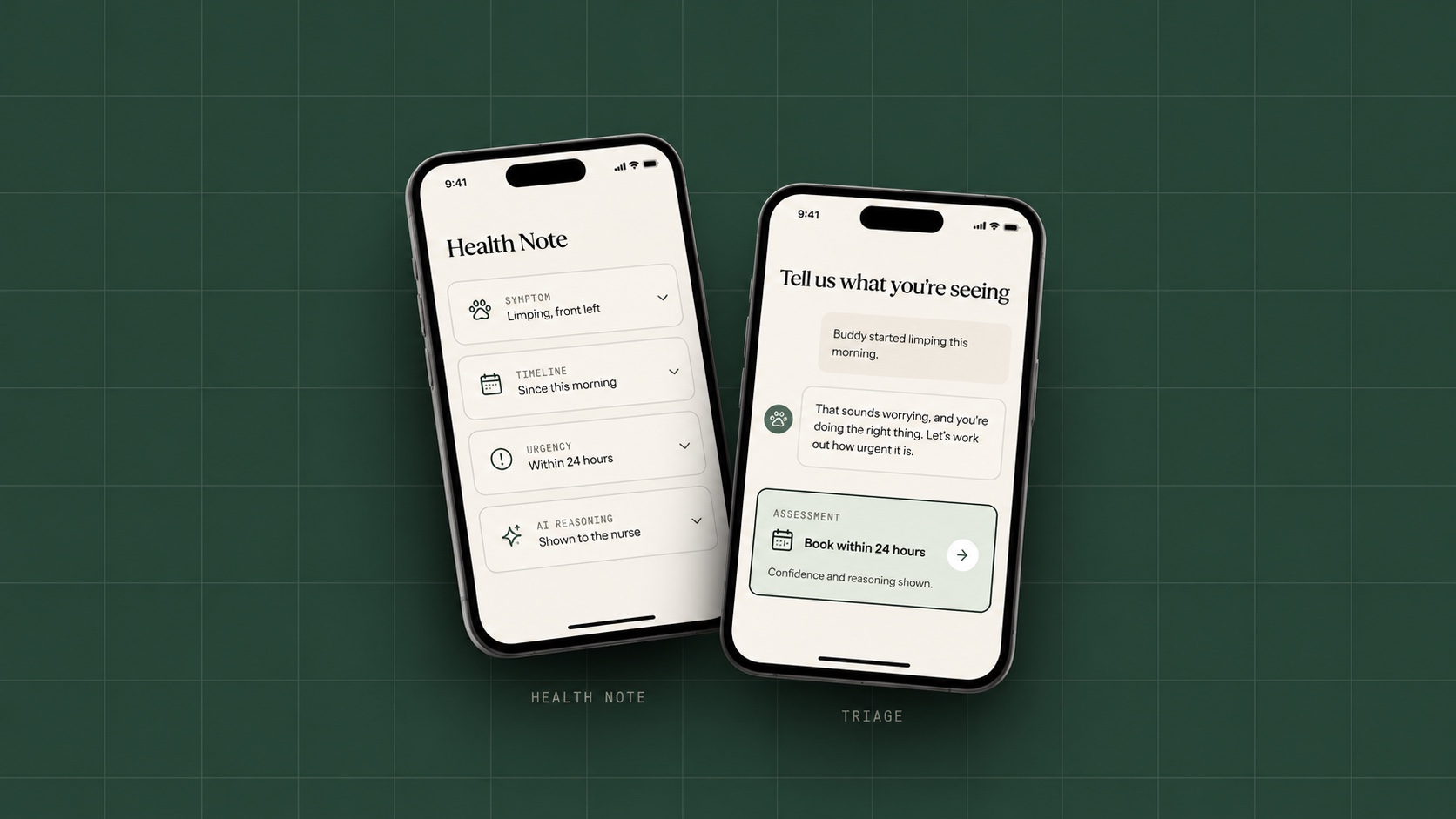
Transparent AI confidence
Confidence scores and reasoning shown, not hidden. Prototype trust rose from 6.2 to 8.7.
One-handed, mobile-first
Built for owners holding a pet. All primary actions sit within thumb reach.
Health Notes, co-designed
Six workshops with eight nurses produced a structured format: symptoms, timeline, urgency and AI reasoning.
08 · How does it feel and stay consistent?
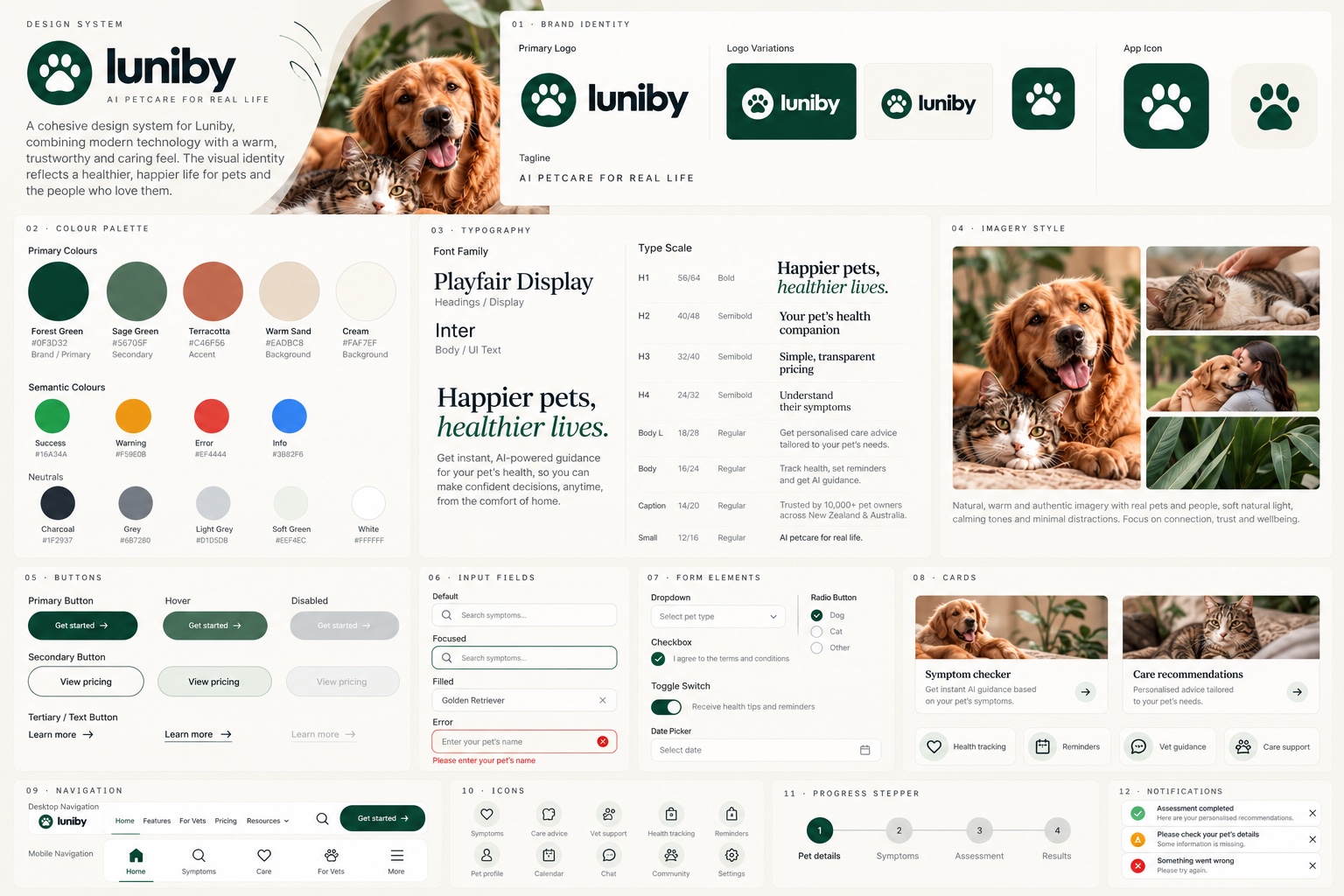
ConductedDesign system
A cohesive design system combines modern technology with a warm, trustworthy and caring feel, so the visual identity reflects a healthier, happier life for pets and the people who love them.
Warm and trustworthy
Forest green, sage and terracotta on cream, with natural, softly lit imagery of real pets and people.
Calm to read
A serif for headlines and a clean sans-serif for body and interface text, on a clear type scale.
Clear in a crisis
Success, warning, error and info colours, plus a step-by-step progress stepper and notifications for the triage flow.
09 · What did it become?
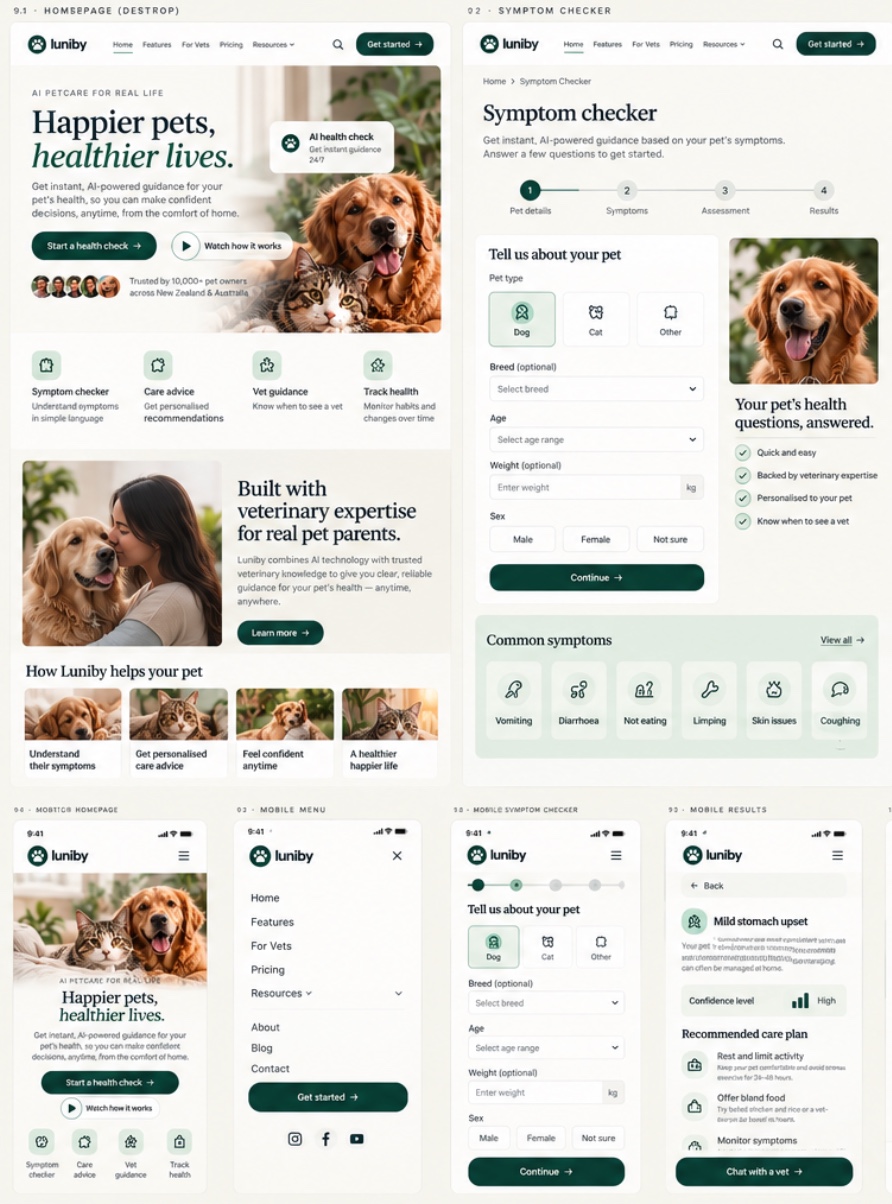
ConductedFinal design
The finished product across devices: a home page that leads with a health check, a four-step symptom checker with clear results and a recommended care plan, transparent pricing, a partner page for vets, and a resources section with vet-consultation booking.
10 · Does it work under stress?
ConductedAccessibility
A worried owner is a situational impairment, so accessibility was treated as a core requirement. The interface targets WCAG 2.1 AA and was checked with screen readers.
Touch and keyboard
44 by 44px minimum targets, tested on five device sizes, with full keyboard support.
Plain language
Flesch-Kincaid grade 8 for all user-facing text, with progressive disclosure for complex information.
Recovery and resilience
Clear error states with recovery actions, and service-worker caching so it still opens in an emergency.
11 · What would I carry forward?
ConductedLearnings
Multi-user design is orchestration: distinct experiences, shared data. Co-designing with nurses beat solo iteration by a wide margin, and transparency is what makes AI trustworthy.
The biggest lesson was commercial. Clinics preferred an embeddable API over a standalone platform, so the roadmap pivoted toward integration. Validating with the buyer, not just the user, changed the product.
Outcomes
What came out of it.
- Reported
Beta live at luniby.com with 220+ registered pet owners, a 78% triage completion rate and 8.9/10 owner satisfaction.
- Reported
Empathetic language reduced measured anxiety by 34% in A/B testing, and showing AI confidence and reasoning raised trust scores from 6.2 to 8.7 in prototype testing.
- Reported
Demos at three veterinary clinics led to one clear signal: clinics wanted triage as an embeddable API for their existing systems, which changed the roadmap.
- Context
Figures come from the project's own pilot, survey and beta data. Small samples, not a controlled study.
Next case study
Acupoints: a clinic website built to turn searches into bookings
Read nextWorking on something similar?
Get in touch